
Our specialty
French oak, which is most of what we sell.
European oak cut long and wide, graded for character rather than uniformity, and usually wire-brushed. It's the floor Phoenix light was made for — and the one clients name in their reviews.
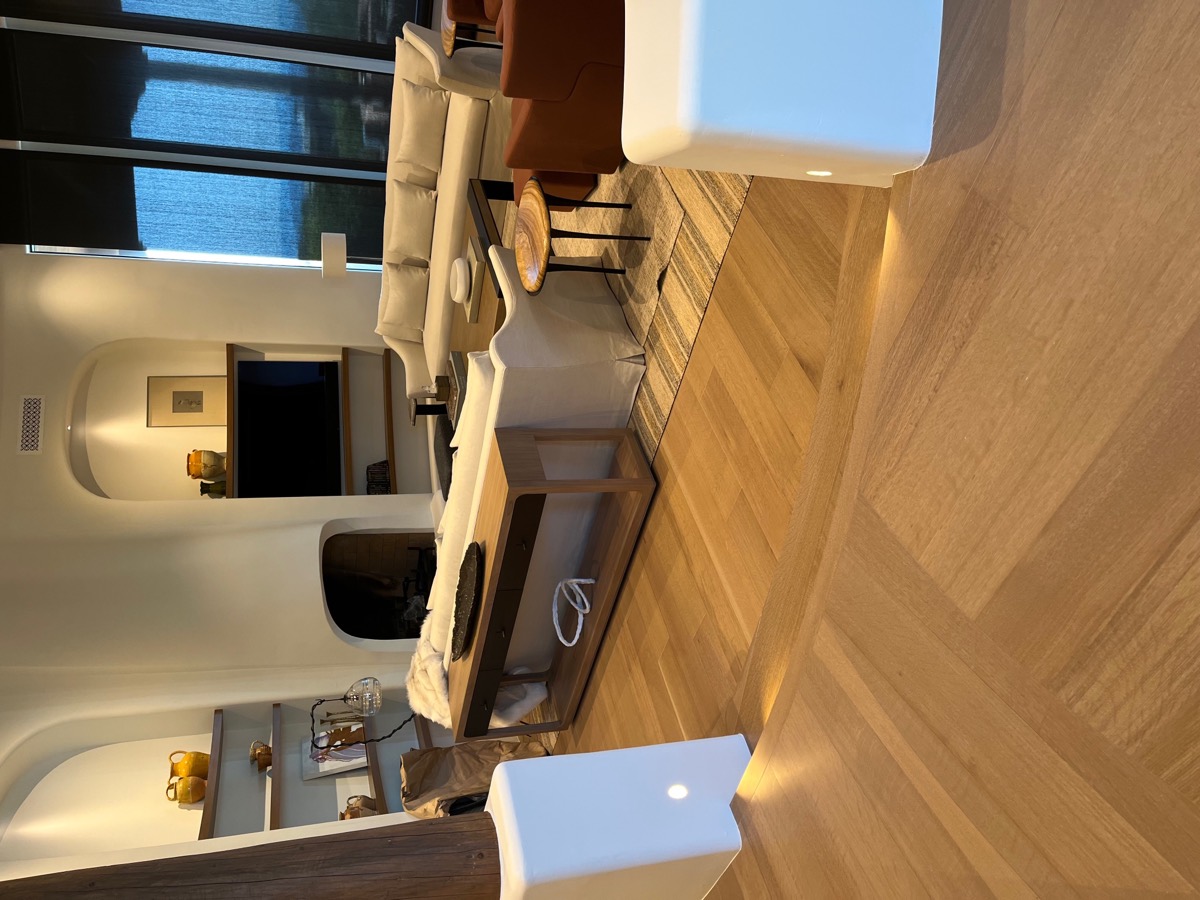
Olympic Hardwood Flooring just finished about 2,000 square feet of French oak at our home and we could not be happier. James P.
What French oak actually is
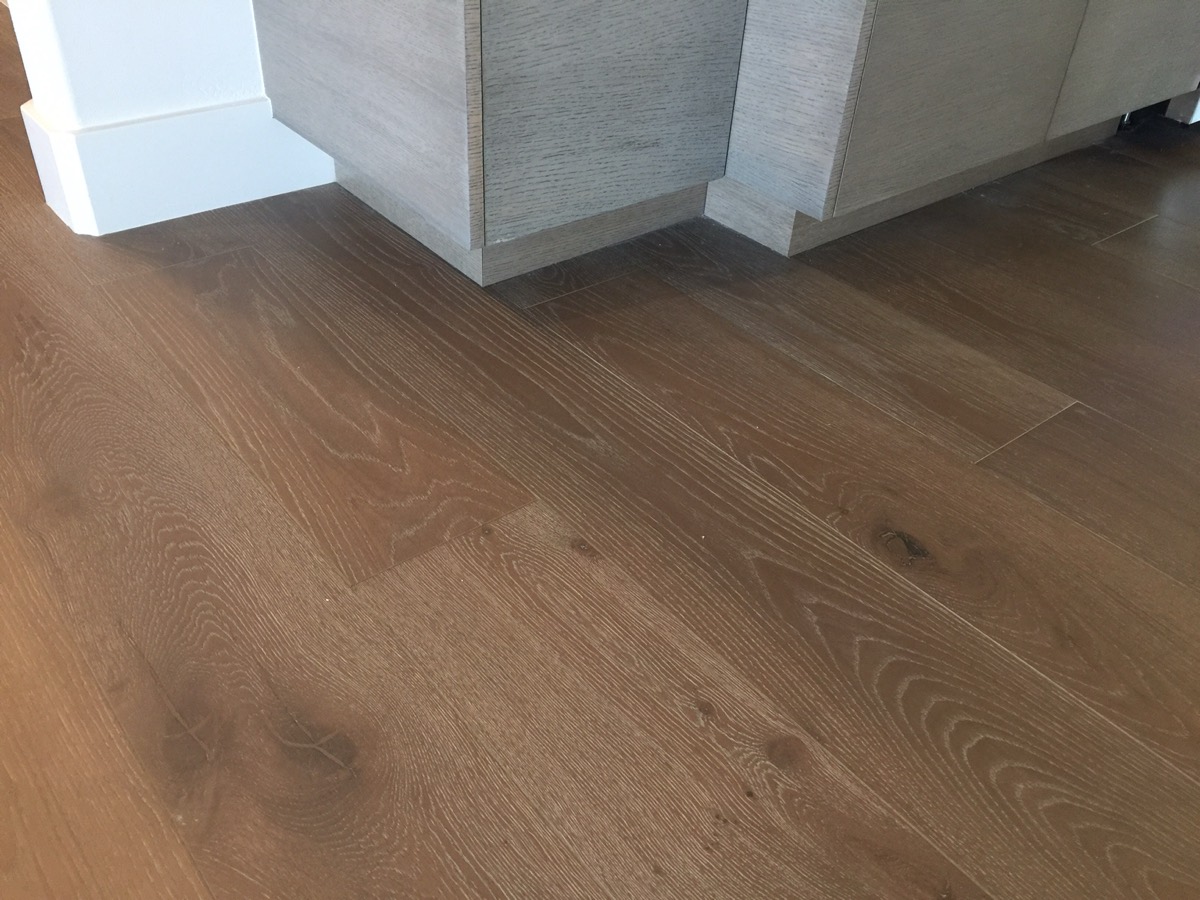
It's European oak — Quercus robur and Quercus petraea — and the difference from American oak is as much about milling philosophy as it is about the tree. European mills cut for length and width, and they grade for character rather than removing it. So a French oak floor keeps its knots, its mineral streaks and its colour variation from board to board.
The grain reads calmer than red oak. Less of the busy cathedral figure, more long quiet lines. That's why French oak takes a pale, natural, barely-there finish so convincingly, and why it doesn't fight with the furniture in a room that's already doing something interesting.
Why it works in a Phoenix house
The construction fits the slab. French oak arrives engineered almost without exception — a sawn oak wear layer over a cross-grained core. That's precisely the build a slab-on-grade home and a house running air conditioning nine months of the year need. Wide solid boards on a slab would be a fight; wide engineered boards aren't.
The texture fits the dust. Fine desert grit acts like sandpaper underfoot and dulls a finish faster here than almost anywhere. Wire-brushing raises the grain instead of levelling it, so light lands unevenly by design and the abrasion that would show as a haze on a smooth high-gloss floor simply doesn't read.
The colour fits the light. Arizona sun is hard and bright, and it ambers finishes and fades pigment faster than milder climates do. Pale, natural-toned oak with a low-sheen finish drifts far less visibly than a dark stain does — and the difference between a traffic lane and the shaded patch under a rug stays subtle instead of becoming a rectangle.
A single French oak plank, full width, flat light - to show grain and wire-brush texture properly.
Select grade next to aged character grade, same frame, for the comparison this page makes.
What's on our wall
The core of our French oak offer is 7½-inch wide plank with a sawn 3 mm wear layer, lightly wire-brushed, finished with UV-cured polyurethane, in a range of colours and character grades. It's a floor that needs no site finishing and no maintenance ritual — and because the wear layer is genuinely thick, it can be sanded later in its life rather than replaced.
Alongside it we carry European oak from makers who work in different registers: DuChâteau splits its offer between a smooth, even select grade and an aged character grade that leans into free-forming grain, knots and cracks; Provenza works in richer colours and hand-crafted surface detail. Which one is right depends entirely on how much movement you want the floor to have.
Character grade is a choice, not a defect
The first time people see aged-character European oak, the knots and streaks can read as flaws. They aren't — they're the reason the floor looks like wood rather than like a product. If you want uniformity, select grade exists and we'll show you both. Just make that call standing on samples, not from photographs.
Width, length and why they matter
A 7½-inch board puts roughly half as many seams across a room as a 3¼-inch strip floor does. The effect isn't subtle: fewer lines means the eye travels further before it's interrupted, and a room reads longer and calmer. Long boards compound it.
The catch is that wide boards are less forgiving. They telegraph an uneven slab, and they punish an installer who skipped the flatness work. That's a large part of why we do our own tile removal and slab preparation rather than inheriting someone else's.
More on the width question on the wide plank page.
Take a sample home
French oak changes character between morning and afternoon light. Borrow boards, put them on your floor, live with them for a day.
Visit the showroom- Walk-insMon–Fri 9–3, no appointment
- Or we come to youHand-picked samples brought to your house
- Call or text(602) 535-1214
French oak questions
What actually makes French oak different from American oak?
It's a different species group — Quercus robur and Quercus petraea, the European oaks — and it's milled differently. European mills cut for long, wide boards and grade for character rather than uniformity, so a French oak floor has visible knots, mineral streaks and colour variation that American red oak is usually graded to remove. The grain is calmer and less busy, which is why it takes a light, natural finish so well.
Is French oak solid or engineered?
Almost always engineered, and that's a feature rather than a compromise here. Wide European oak boards are dimensionally happier as a cross-grained engineered panel, which is exactly what a Phoenix slab and dry indoor air require. The wear layer is real sawn oak — 3 mm or more on the products we carry — so it looks, sands and ages like solid wood.
Does French oak hold up in Arizona?
Yes, and it's one of the better choices here. Oak's open grain hides everyday scratching, engineered construction handles the slab and the dry air, and the wire-brushed textures most French oak arrives in disguise the fine abrasion that desert dust causes. The finish matters as much as the wood: a lower sheen and a UV-conscious finish system keep the floor looking even under hard Arizona light.
How wide are the boards?
The French oak we stock runs to 7½ inches, and wider options exist. Width changes a room more than colour does — fewer seams across the floor means longer sightlines and a calmer surface. It also raises the standard of the subfloor preparation, because wide boards are less forgiving of an uneven slab.
Can French oak be refinished?
A good one, yes. That's what the wear layer thickness buys you: a 3 mm sawn layer will normally take a full sand or a couple of light ones. Thin rotary-peeled veneers cannot. We'll tell you which you're looking at before you buy, because it's the difference between a floor you keep and a floor you replace.
Is French oak more expensive?
Generally yes, and the reasons are real: longer and wider boards, European milling, character grading and multi-step finishing all cost more than a standard domestic strip floor. Whether it's worth it depends on the room. Come and stand on both in the showroom — that comparison settles the question faster than any number does.
Stand on it before you buy it.
Walk in Mon–Fri 9–3 on N 24th Ave, or we'll bring a hand-picked set of French oak samples to your house.