
Before the hardwood goes down
Tile out, dust contained, slab ready.
In most Phoenix homes the hardwood project starts with demolition. How that demolition is done decides how clean your house stays — and how well the new floor bonds.
Why tile removal is its own job in Arizona
Valley houses sit on concrete slabs, and a great many of them were tiled from the front door to the back wall. When homeowners move to wood, that tile has to come up first — and the slab underneath is the foundation everything else depends on.
Tile is bonded to the slab with thinset mortar. Over the years, heat cycling, minor slab movement and old patch repairs leave a patchwork of bond strengths across a single room. Some tiles release with a tap. Others hold so hard that getting them off chips or gouges the concrete underneath. Every one of those gouges is a repair before the new floor can be laid.
Then there's the dust. Breaking tile, grinding thinset and chasing old adhesive produces fine abrasive particles that travel — into HVAC returns, into cabinets, into the fabric of the house. Beyond the obvious nuisance, dust left sitting on the slab compromises the adhesive bond of a glue-down hardwood floor. That shows up months later as hollow spots and noise underfoot, and by then nobody connects it back to demolition day.
The honest word is "contained"
Cutting tile and grinding mortar makes dust; physics doesn't negotiate. What a proper dust-controlled removal changes is where that dust ends up. Vacuum-shrouded tools capture it at the source, the work area is sealed, and the HVAC returns are covered so nothing gets distributed through the ducts. The difference between that and an open demolition is the difference between a normal week and a house you're still cleaning at Christmas.
How we do it
-
Seal and protect
Work area sealed off from the rest of the house, HVAC returns covered, doorways masked, and anything staying in the room protected.
-
Lift the tile
Tile and stone come up on vacuum-shrouded equipment so the dust is captured where it's made rather than after it's airborne.
-
Grind the thinset back
The slower half of the job. Old mortar and adhesive have to come off the concrete completely — a slab with thinset ridges left on it can't be levelled and can't be bonded to.
-
Repair and flatten the slab
Chips and gouges filled, high spots ground down, the whole floor brought inside the flatness tolerance hardwood needs — about 3/16 of an inch over 10 feet.
-
Clean, test, and hand it to the installers
The slab is vacuumed clean and moisture-tested before a single board arrives. Same company, same standard — which is the point of not splitting this work between two contractors.
Containment in place: sealed doorway, covered HVAC return, plastic up.
Vacuum-shrouded grinder taking thinset off the slab.
Half-removed tile floor - the clearest before/after in one frame.
The finished slab: clean, ground flat, ready for wood.
What comes up, and how hard it is
| Existing floor | What's involved |
|---|---|
| Ceramic & porcelain tile | The common case. Bond strength varies tile to tile; the thinset grind is the bulk of the labour. |
| Natural stone & saltillo | Heavier, thicker and slower. Saltillo in particular tends to have been set in a deep mortar bed that all has to come off. |
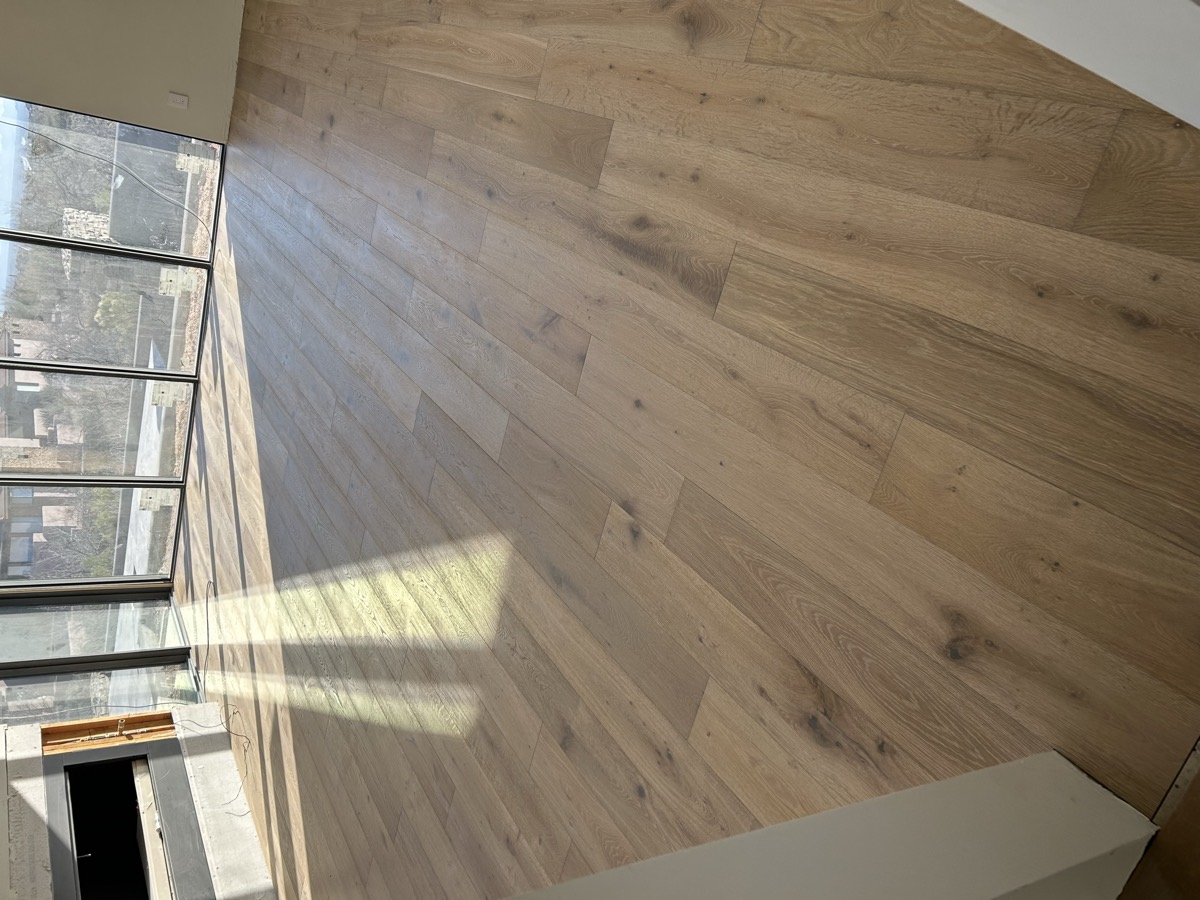
| Glued-down wood | Its own category of stubborn — the adhesive has to be removed from the concrete as well as the boards. We've done it and replaced the result with wide plank French oak. |
| Carpet & laminate | The easy ones. Tack strip, staples and old underlay come out; the slab still gets checked and prepped. |
One contractor, one accountable slab
Plenty of homeowners hire a demolition crew, then a flooring company. It saves money on paper and creates a gap in practice: when the new floor has a hollow spot, the installer says the slab wasn't prepped and the demolition crew is long gone.
We do the removal because we're the ones laying the floor over it. If the slab isn't right, it's our problem before it's yours. That's also why we'd rather not take tile-removal work that isn't attached to a hardwood project — it's preparation, not a standalone product.
Once the slab is clean, flat and dry, the rest of the project picks up on the installation page.
Planning a tile-to-wood conversion?
Tell us the square footage and what's down now. We'll walk you through the sequence and the realistic timeline.
Get a free estimate- Call or text(602) 535-1214
- Showroom10801 N 24th Ave #112, Phoenix — walk-ins Mon–Fri 9–3
Tile removal questions we get asked
Is dust-free tile removal really dust-free?
It's dust-contained, and we'd rather use that word. Cutting tile and grinding thinset creates fine silica dust by definition; the difference is whether it's captured at the tool or allowed to travel through your house. Our removal runs on vacuum-shrouded equipment with the rooms sealed off and HVAC returns covered. You won't get a house that needs repainting.
Why does the dust matter so much?
Two reasons. The obvious one is that fine grit settles into cabinets, HVAC returns and soft furnishings and keeps reappearing for months. The less obvious one is that dust left on the slab compromises the adhesive bond of the new floor, which shows up later as hollow spots and noise. A clean slab isn't a courtesy, it's part of the installation.
Do I need to move out during tile removal?
Usually not. We seal the work area, run containment, and work room by room where the layout allows it. It is loud — there's no version of breaking up tile that's quiet — so people with small children or anyone working from home often prefer to be out during the noisiest days. We tell you in advance which days those are.
What happens to the slab underneath?
That's the real work. Tile is bonded to the slab with thinset mortar, and after years of heat, minor slab movement and old repairs, some tiles lift cleanly while others hold so hard that removing them chips the concrete. Every gouge has to be repaired and the slab ground or filled flat — roughly 3/16 inch over 10 feet — before hardwood can go down.
Do you remove stone, saltillo and glued-down wood too?
Yes. Natural stone and saltillo are heavier and slower than ceramic. Glued-down wood is its own job, because the adhesive has to come off the concrete as well as the boards. All of it is routine for our crews.
Can I hire you just for the tile removal?
Our tile removal exists as preparation for a floor we're installing — that's how we can stand behind the slab the new floor lands on. If you have a hardwood project, this is part of it. If you only need demolition, we'd rather point you to a specialist than take work we're not set up for.
Tile now, wood next.
Come see what's replacing it first — 1,000+ samples in the Phoenix showroom, walk-ins welcome.